Isabgol is a Persian name, usually glossed as "horse ear", for the seed of a small plantain. Related plantain seeds were medicine in Greek, Arabic and Persian texts many centuries ago. The documented history of isabgol in India is much younger: colonial pharmacopoeias in the 1800s, then large-scale farming in Gujarat and Rajasthan in the 1900s.
Disclosure: hüsko sells isabgol. A long and romantic history would suit us commercially, which is why every claim below links to the source it came from, including the claims we could not confirm.
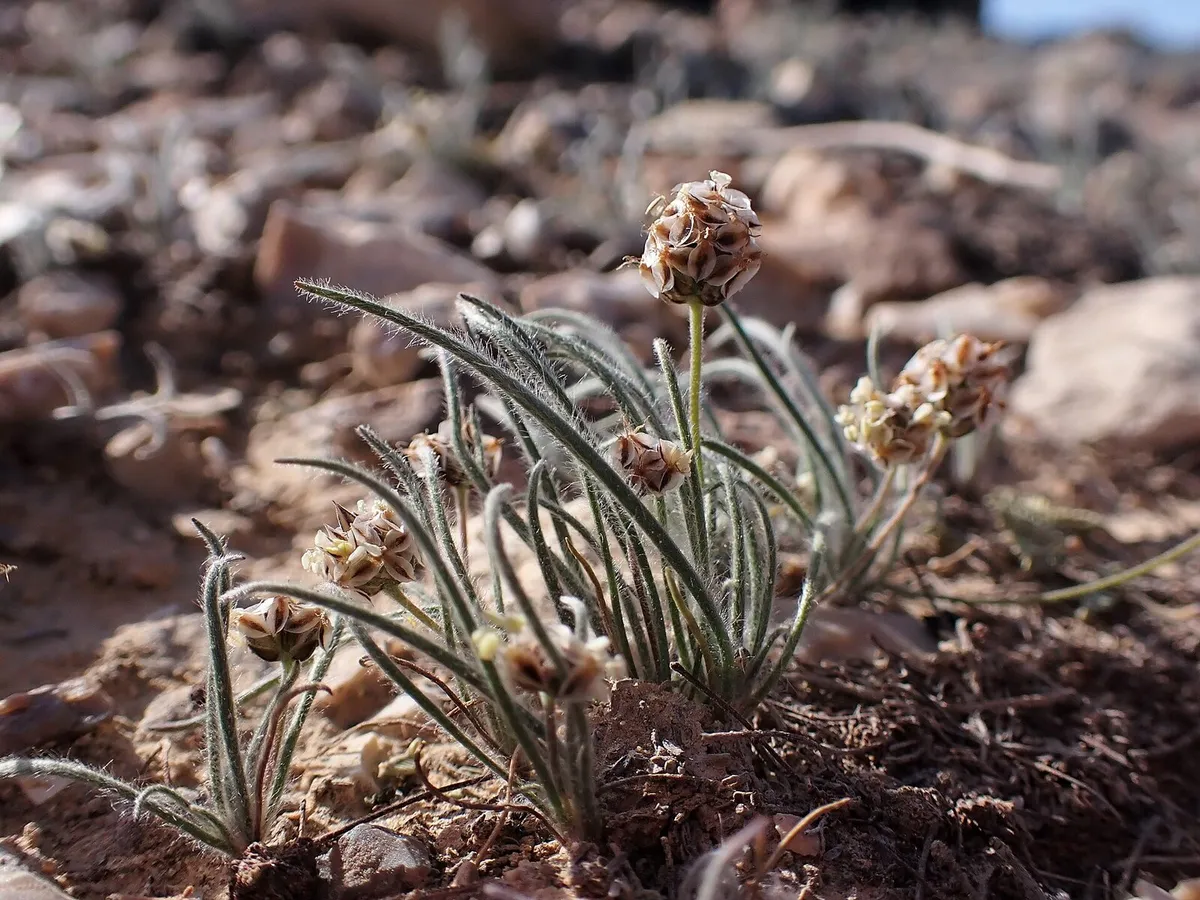

What does isabgol mean?
Isabgol is the Indian form of a Persian compound, asp or esb (horse) plus ghol (ear), so literally "horse ear". The explanation that the seed looks like a horse's ear is a 19th-century gloss. We found no older source that says why the plant got the name.
The most careful reference is the Encyclopaedia Iranica entry "Bārhang" by Hakim Mohammed Said (1988). It calls asb-/esba-ḡūl, "lit. 'horse ear'", a "now obsolete (dialectal?)" Persian name, and applies it to Plantago psyllium, a Mediterranean relative of the plant sold as isabgol today, Plantago ovata. It adds that the name "seems to be still in use in Indian bāzārs", and its source for that is a book from 1890s Bombay.
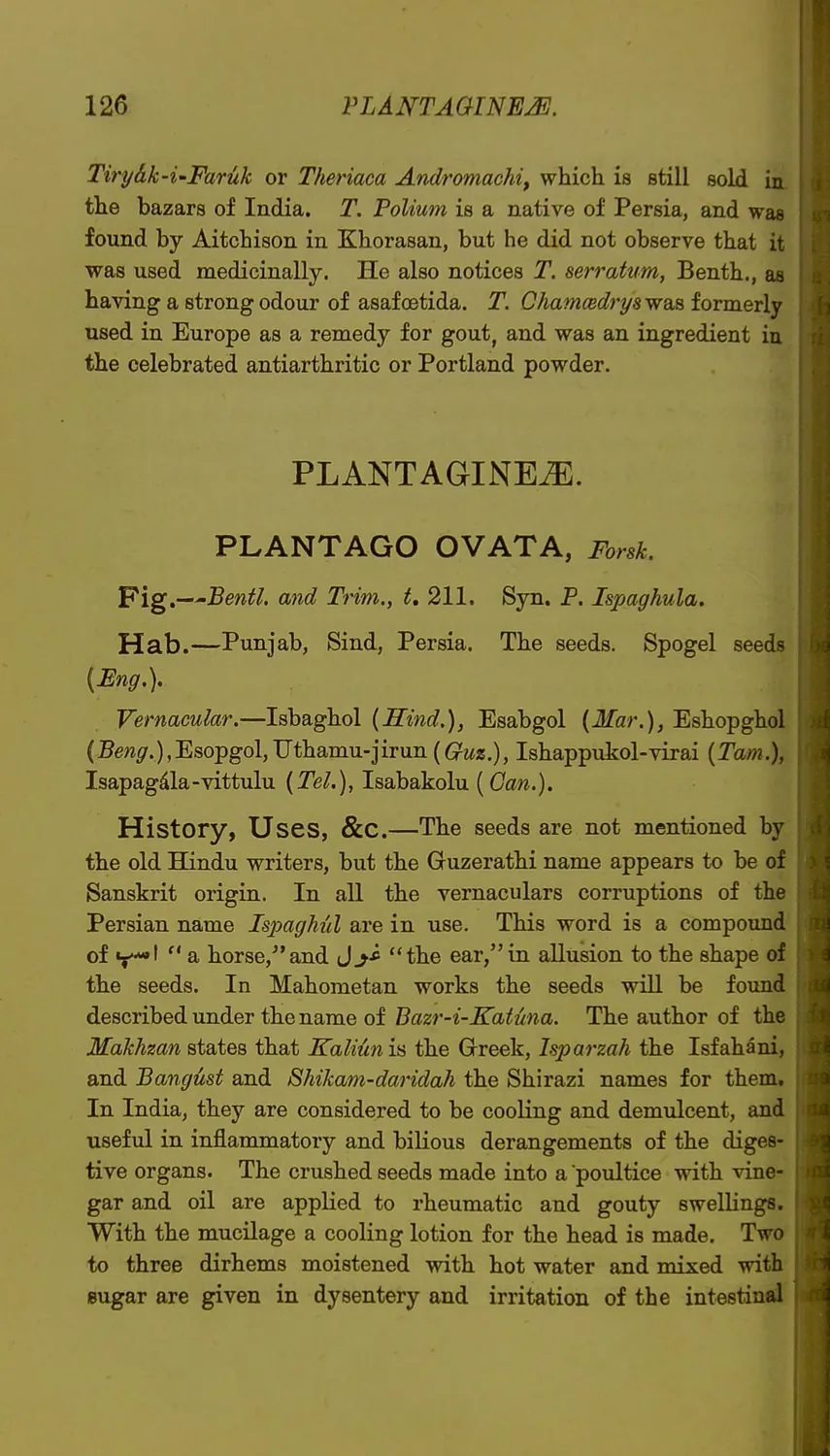
That book is Pharmacographia Indica by Dymock, Warden and Hooper. Its third volume says the Persian word Ispaghúl is "a compound of 'a horse,' and 'the ear,' in allusion to the shape of the seeds." That is the earliest version of the shape story we could find.
Dictionaries are drier. Steingass's 1892 Comprehensive Persian-English Dictionary gives ispaghol, aspaghol simply as "Seed of fleawort", with no etymology. The same dictionary lists ḵẖar-g̠ẖūl as "a plant called ass's ear", which fits the "animal plus ear" pattern. Hobson-Jobson, the Anglo-Indian glossary, has no entry for the word in its searchable 1903 edition.
Why is it also called ispaghula and psyllium?
Ispaghula comes from botany, not from a shop. In 1810 William Roxburgh named the plant Plantago ispaghul, later spelt ispaghula, from the Persian word. Psyllium is older and Greek: Dioscorides called a flea-seeded plantain psyllion, from psylla, a flea.
Bentley and Trimen's Medicinal Plants (1880) notes the spelling change, "Ispaghul in the 'Asiatic Researches,' but Ispaghula in the later 'Flora Indica'", and gives the English trade name "Spogel seeds". British pharmacy kept "ispaghula" for the husk. American labelling went with psyllium, and the US regulation still describes P. ovata as "blond psyllium or Indian psyllium".
Did the ancient Greeks use isabgol?
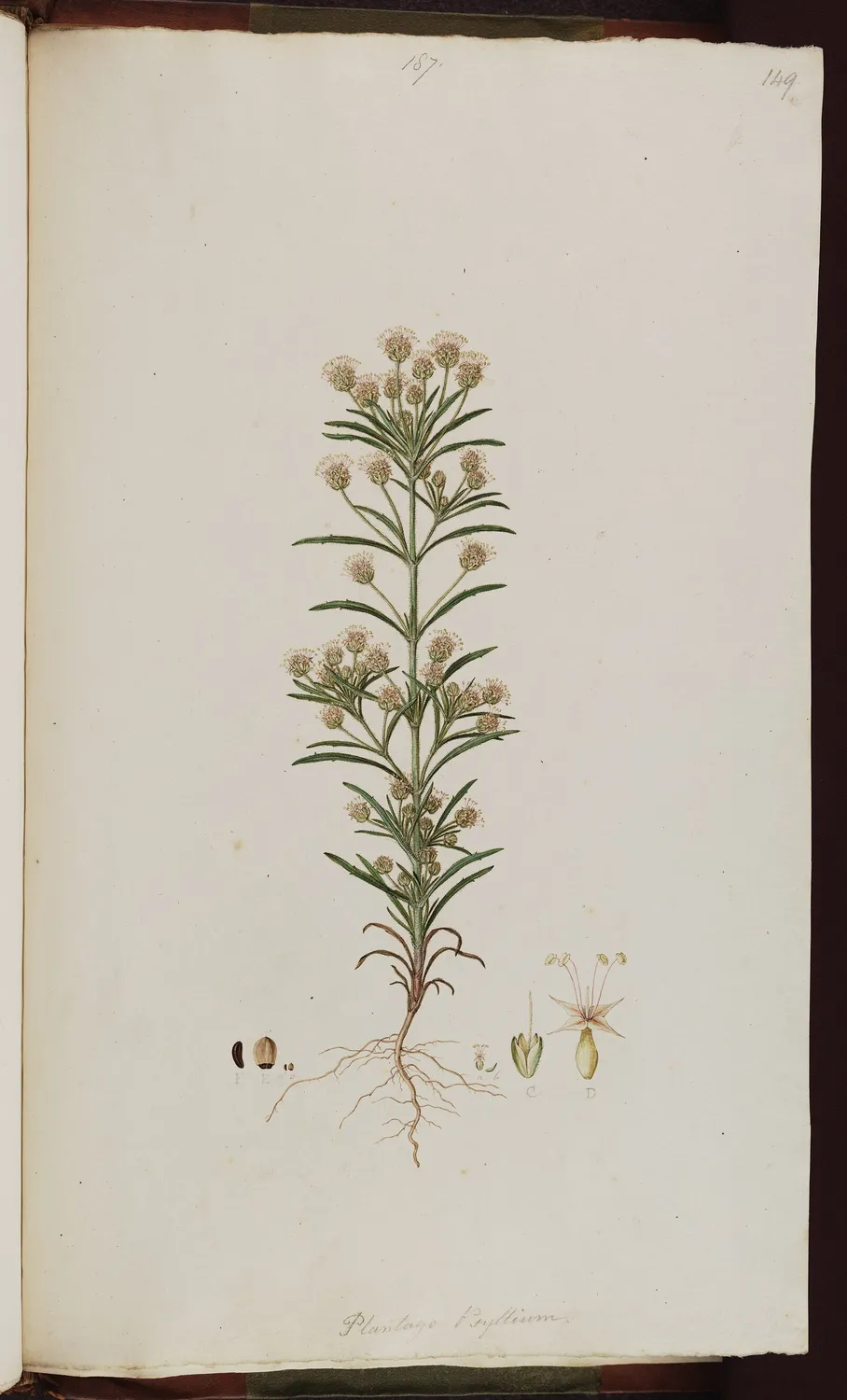
Not exactly. Greek medicine used a related plantain seed. In the 1st century CE Dioscorides described psyllion, with hard, black, flea-like seeds, as a cooling poultice. Modern botanists identify it as Plantago psyllium (now P. afra), not P. ovata. It was used on the skin, not taken as a laxative.
In Book 4 of De Materia Medica (chapter 70 in Berendes's 1902 German translation), Dioscorides recommends the seed for gout, swellings and headaches. He tells the reader to soak it in water and spread it on once the water has turned thick. He had noticed the mucilage, the same gel that makes isabgol work. He did not prescribe it for the bowels.

How did isabgol enter Arabic and Persian medicine?
Through translation. Islamic-era physicians took over the Greek account of psyllion and gave it the Arabic name bazr qaṭūnā. The Persian physician al-Harawi described the seeds in the 10th century, and Avicenna did so shortly afterwards. Unani medicine in India grew out of this tradition.
Flückiger and Hanbury's Pharmacographia (2nd edition, 1879, p. 490) says the seeds "are generally designated by the Persian word Ispaghúl" but also "bear the Arabic name Bazre-qatúna, under which we find them mentioned by the Persian physician Alhervi in the 10th century, and about the same period or a little later by Avicenna." It also warns that these older references "may possibly have included the seeds of other species". Iranica says the same: the Arabic and Persian sources mostly "repeat more or less fully" Dioscorides and Galen.
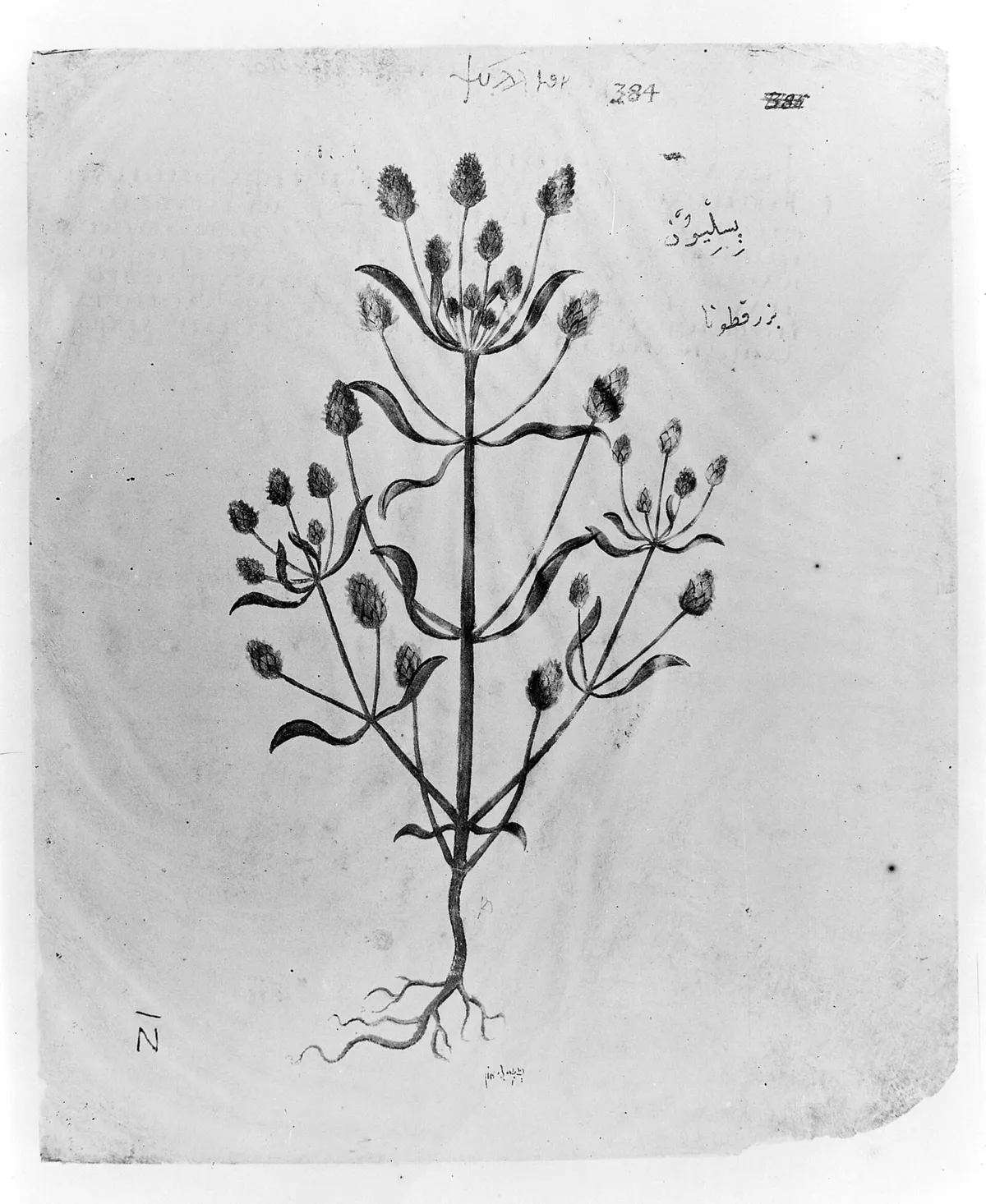
The page below shows that link directly. In the Vienna Dioscorides, a Greek manuscript made around 512 CE, a later hand has written two names beside the psyllion drawing in Arabic script: bisulyun (from the Greek) and bazr qaṭūnā.

Is isabgol mentioned in Ayurveda?
We could not find it in a classical Ayurvedic text. The two great Victorian surveys of Indian drugs both say it is absent. Watt (1892) wrote that the seeds "are not mentioned by Sanskrit writers on medicine, and were apparently unknown to them". Dymock wrote that they "are not mentioned by the old Hindu writers".
The Watt entry, in Volume VI of A Dictionary of the Economic Products of India, places the drug's reputation with "Arabian and Persian writers, who appear to have long held the medicine in high esteem". Modern websites give Sanskrit names such as ashvakarna or snigdhajiraka and credit them to texts like the Bhavaprakasha. None of the ones we checked quotes a verse or cites an edition.
The colonial authors may have missed something, and we would rather say so than pretend otherwise. Even in 1880, Bentley and Trimen wrote in a footnote that Ispaghúl was "the Sanskrit name for the seeds", which is wrong: the word is Persian. If a classical citation exists, it should be easy to quote. We have not seen one.
How did isabgol become an official medicine?
Through British India. Europeans noticed the seed in 1719, and doctors in Bengal used it for dysentery and diarrhoea around 1800. The Pharmacopoeia of India made the seeds official in 1868. In 1900 the Indian and Colonial Addendum to the British Pharmacopoeia listed "Ispaghula" for India and the Eastern colonies.
Flückiger and Hanbury credit J. H. Linck with describing the seed in 1719, "yet without knowing its name". Watt names the doctors who popularised it in India: Fleming, Ainslie, Roxburgh and Twining, whose Diseases of Bengal praised it for chronic diarrhoea.
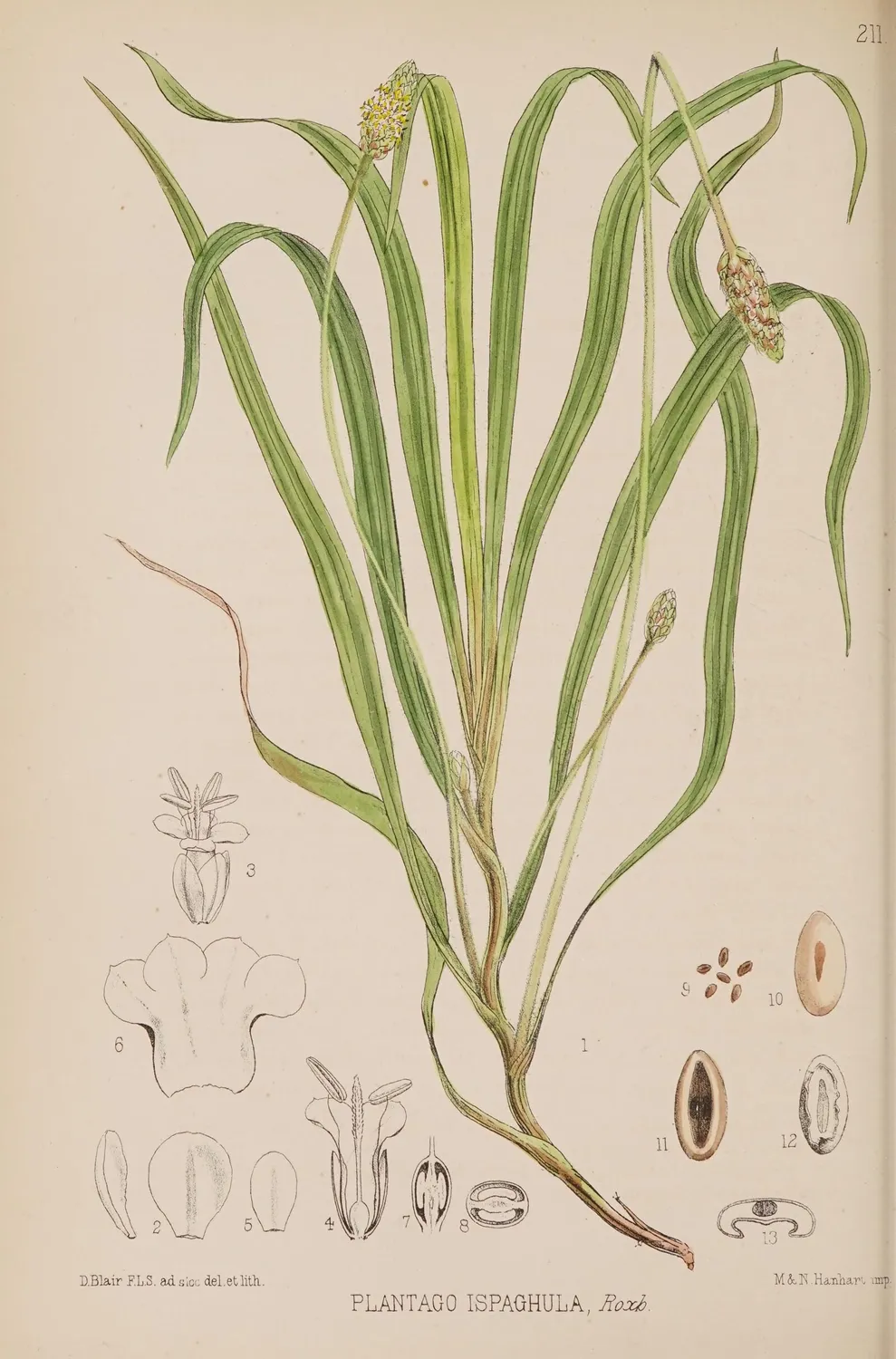
In 1880, Bentley and Trimen noted that the seeds were "not official in the British Pharmacopoeia, or the Pharmacopoeia of the United States". The 1900 Addendum defines Ispaghula as "the seeds of Plantago ovata", cites Bentley and Trimen's plate 211, and gives a dose of 50 to 150 grains.
When did India start growing isabgol?
Later than most people assume. In the 1890s Dymock recorded that "Large quantities of these seeds are imported into Bombay from Persia". Watt found only small-scale cultivation around Multan, Lahore, Bengal and Mysore. We could not find a documented start date for the Gujarat crop.
Watt's 1892 entry puts the wild plant in "the Panjáb plains and low hills, from the Sutlej westwards". It reports that one botanist said it was "never cultivated in the Panjáb, except, perhaps, sparingly at Lahore." That is not a picture of an established Indian crop.
By the 1970s it was established. ICAR's Indian Horticulture (Das and Trivedi, 2023) dates the first released variety, Gujarat Isabgol-1, to 1976. It was bred at Anand from "introduced material". The same article says the crop "has been introduced and cultivated in North Gujarat and adjoining parts of Western Rajasthan and Madhya Pradesh". The ICAR directorate at Boriavi, near Anand, released the Vallabh varieties in 2015 and 2016. The years between, roughly 1900 to 1970, are the gap in this story. The production side is covered in where isabgol comes from.
How did psyllium reach Western pharmacies?
As a branded laxative, then as a regulated heart-health ingredient. G. D. Searle marketed Metamucil, a psyllium product, from 1934. In 1998 the US FDA allowed foods containing psyllium husk to carry a health claim about soluble fibre and the risk of coronary heart disease.
The Science History Institute's catalogue entry for an old Metamucil bottle states that "G.D. Searle & Company marketed 'Metamucil' from 1934 until 1985." The FDA's final rule of 18 February 1998 added psyllium to the soluble fibre claim in 21 CFR 101.81. The claim requires at least 7 g of soluble fibre from psyllium husk a day, as part of a diet low in saturated fat and cholesterol. We looked at what the cholesterol trials actually show in does isabgol lower cholesterol?.
A timeline of what is documented
| Year | Event | Source |
|---|---|---|
| 1st century CE | Dioscorides describes psyllion (a related plantain) as a cooling poultice | Berendes translation, 1902 |
| c. 512 | Vienna Dioscorides illustrates psyllion; Arabic-script names added later | Wellcome Collection |
| 10th to 11th century | al-Harawi, then Avicenna, describe the seeds as bazr qaṭūnā | Flückiger and Hanbury, 1879 |
| 1719 | J. H. Linck describes the seed in Europe without knowing its name | Flückiger and Hanbury, 1879 |
| 1810 | Roxburgh names Plantago ispaghul; Fleming lists the drug in Calcutta | Bentley and Trimen, 1880 |
| 1868 | Seeds made official in the Pharmacopoeia of India | Watt, 1892 |
| 1890s | Seeds still largely imported into Bombay from Persia | Pharmacographia Indica |
| 1900 | Ispaghula listed in the Indian and Colonial Addendum to the British Pharmacopoeia | Addendum, 1900 |
| 1934 | G. D. Searle begins marketing Metamucil | Science History Institute |
| 1976 | Gujarat Isabgol-1, the first released Indian variety | ICAR, 2023 |
| 1998 | US FDA allows a psyllium soluble fibre and heart disease claim | Federal Register |
| 2015 to 2016 | ICAR-DMAPR, Boriavi releases the Vallabh Isabgol varieties | ICAR, 2023 |
What is often repeated, but we could not source
These claims are all over the internet. We looked for a primary source for each and did not find one.
- "Used in Ayurveda for thousands of years." Both major 1890s surveys say the opposite, and we found no quoted classical verse.
- "Named horse ear because the seed looks like a horse's ear." The literal meaning is well attested. The reason given is a 19th-century explanation, not an old one.
- "Introduced to India by Mughal rulers or Arab traders." This is plausible given the Persian name, but we found no document.
- "Sat Isabgol went on sale in 1937." Wikipedia gives this date and cites a 2015 Guardian article that we could not locate.
- "Grown in Gujarat for centuries." Records from the 1890s describe seeds imported from Persia and very little Indian cultivation.
If you have a primary source for any of these, we would like to see it, and we will correct this page.
What this adds up to
The name is Persian, and its literal meaning, horse ear, is documented. The medicine is old, but its paper trail runs through Greek, Arabic and Persian texts, and those texts mostly describe related plantains rather than Plantago ovata itself. India's own story is recent and well recorded: official recognition in 1868, imports from Persia in the 1890s, the first Gujarat variety in 1976, and today's position as the main exporter.
That is less romantic than "centuries of Ayurveda", and it is more interesting. A seed that physicians in Baghdad and Isfahan valued, and Bombay imported from Persia, now comes mostly from fields in Gujarat and Rajasthan. If you take it, the practical questions are covered in can you take isabgol every day?.